
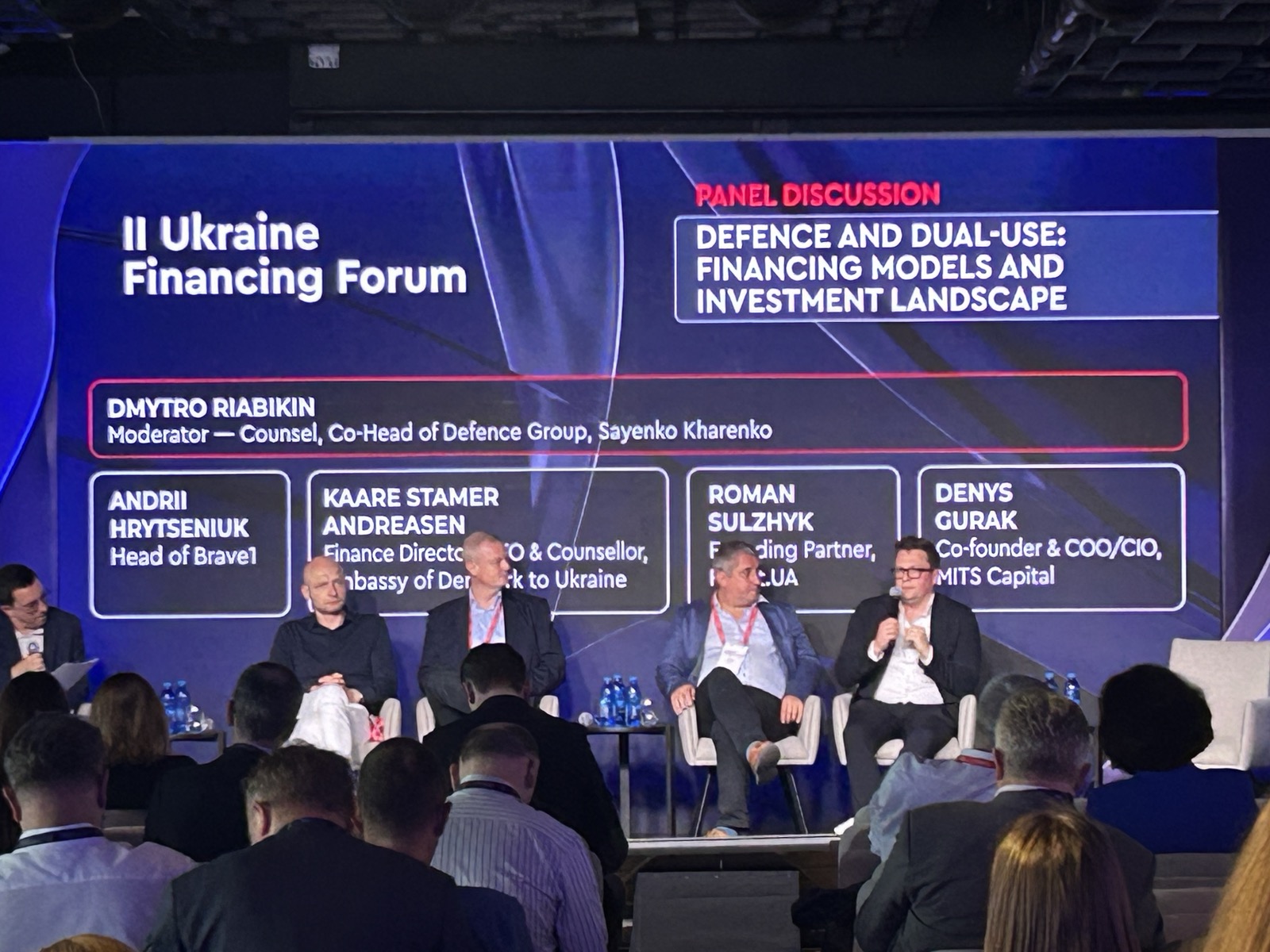
he II Ukraine Financing Forum brought senior figures from international financial institutions, development finance bodies, export credit agencies, and Ukrainian industry to a single question: how is capital actually being deployed into Ukraine’s defence and dual-use sector today, and what needs to change for investment to scale?
Ralph Klotz joined the panel on Defence and Dual-Use: Financing Models and Investment Landscape. Panelists included Andrii Hrytseniuk, Head of Brave1 (Ukraine’s government-backed defence tech cluster); Kaare Stamer Andreasen, Finance Director and CFO at the Embassy of Denmark to Ukraine; Denys Gurak, Co-founder and COO/CIO of MITS Capital (a defence-focused investment bank operating across Kyiv and New York); and Roman Sulzhyk, Founding Partner of a Ukrainian-based investment firm. Dmytro Riabikin, Counsel and Co-Head of the Defence Group at Sayenko Kharenko, moderated.
Where investment stands
Private investment in Ukrainian defence tech runs at approximately $50 to $100 million per year, by MITS Capital’s own estimate. For a sector producing frontline-tested innovations in drone interceptors, electronic warfare systems, ground robotics, and autonomous platforms at a pace no peacetime R&D budget has matched, that figure points to missing structures, not missing interest.
The EU committed €161 million to Ukraine’s defence and dual-use technologies in 2026. Brave1 is running ₴2.7 billion in grants for defence startups. Denmark, through EIFO and the embassy, is building inaugural financing structures in the sector. Capital is moving. The question the panel kept returning to was the infrastructure to deploy it safely and at pace.
The legal reality most investors miss
Ukraine’s Criminal Code, Article 333, prohibits the direct export of military technology without government authorisation. Most international deal teams do not have that in their pre-meeting briefing. Every transaction is shaped by it.
TriSovereign took this legal reality as a starting point. Our UK entity holds IP custody under DEF STAN 05-138 governance, with JOSCAR registration and NATO NCAGE credentials giving allied buyers and investors the compliance framework they need. Our licensed manufacturing facility in Croatia sits inside EU and NATO-aligned quality frameworks, bypassing the 12 to 30-month licensing delays that block direct export routes. Our Kyiv team works embedded, field-testing technologies and building the commercial and legal foundations Ukrainian companies need before they can scale.
We operate in both directions: giving allied buyers and investors structured access to Ukraine’s innovation ecosystem, and helping Ukrainian companies build the foundations to reach international markets through lawful structures.
What the forum confirmed
The conversation in Kyiv was precise and the panel well-matched. Senior figures from government, finance, and defence innovation were asking the right questions about deal structures, compliance routes, and what bankable investment in this sector actually looks like.
Forums like this one concentrate the people who can move capital once the legal and commercial infrastructure is in place. The infrastructure needs to precede the capital. That is the sequence, and it is where TriSovereign does its work.
If you are an investor, buyer, or institution mapping the defence and dual-use financing landscape, contact us. The conversation is worth having.
info@tri-sovereign.co.uk | +44 330 533 0485 | www.tri-sovereign.co.uk 128 City Road, London EC1V 2NX
UK Reg. 16484732 · JOSCAR Registered · NATO NCAGE U2DX1 · DEF STAN 05-138